If you've started researching jiu jitsu, you've probably already run into the terms "gi" and "no-gi" and wondered what the difference actually means for you as a beginner. Both are legitimate, effective forms of Brazilian Jiu Jitsu — but they train differently, and picking the right starting point can shape your early experience on the mats.
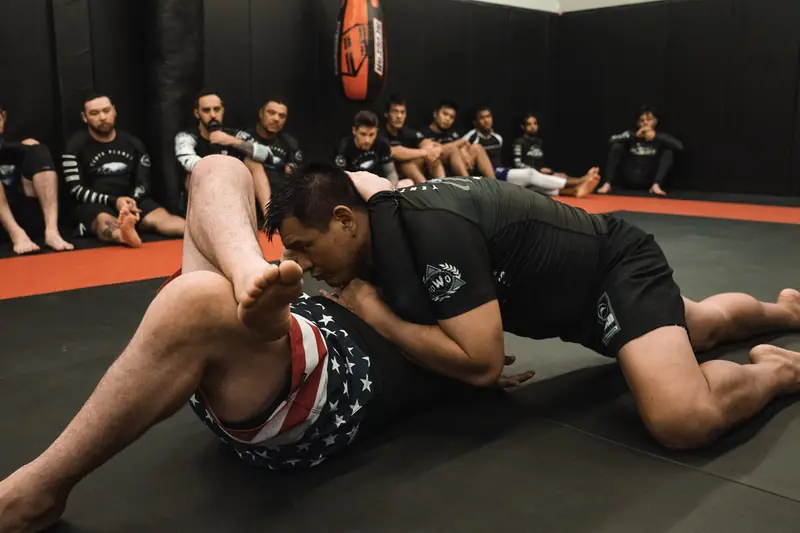
What's the Difference?
Gi jiu jitsu is trained wearing a traditional uniform — a heavy cotton jacket and pants, similar to a judo gi — that can be grabbed, gripped, and used as a tool for control and submissions. No-gi jiu jitsu is trained in rash guards, fitted shirts, and shorts or spats, removing the fabric grips entirely. Without the gi to grab, no-gi grappling relies more on underhooks, overhooks, and wrestling-style body control.
Pace and Style
No-gi tends to move faster. Without fabric grips slowing exchanges down, scrambles happen quicker and positions change more rapidly — which is part of why no-gi has become the dominant style in MMA. Gi jiu jitsu, by contrast, often plays out a bit more methodically, with grip fighting becoming its own layer of strategy.
Self Defense and Real-World Application
A common question from beginners is which style translates better to real self-defense situations. The honest answer is that both teach the underlying principles — leverage, control, escaping bad positions — that matter most in a real confrontation. That said, no-gi tends to mirror real-world clothing more closely (nobody attacking you on the street is wearing a thick cotton jacket you can grab), which is one reason systems like 10th Planet, built by Eddie Bravo, are no-gi focused from the ground up.
Cost and Gear
This is where no-gi has a clear practical advantage for beginners. A quality gi typically costs $80–150, while no-gi training only requires a rash guard and athletic shorts or spats you may already own — items in the $20–40 range. If you're trying jiu jitsu for the first time and want to keep startup costs low, no-gi is the more accessible entry point.
Which Should a Beginner Choose?
- Choose no-gi if: you want a faster-paced, lower-cost entry point, you're interested in MMA or self-defense application, or you simply find the gi uncomfortable.
- Choose gi if: you're drawn to traditional BJJ lineage and competition formats, or you want to develop grip strength and a different technical toolbox.
The good news is that the core principles — positional hierarchy, leverage over strength, staying calm under pressure — transfer between the two. Many high-level practitioners train both. But if you're just getting started and want the most direct path to functional, modern grappling, no-gi is the more efficient starting point for most beginners.
Why We Went All-In on No-Gi in Murrieta
Our academy made a deliberate choice: 100% no-gi, all the time. Here's why that matters for you as a beginner in the Temecula Valley. No-gi is faster-paced and more scrambly — there's no fabric to stall with, so you're always moving, always problem-solving. It's also more accessible: no $150 uniform to buy before your first class, no complex grip-fighting to learn before you can play the game.
And practically speaking, no-gi skills transfer directly to the real world, where nobody wears a heavy canvas jacket. For self-defense, for MMA curiosity, or just for the love of the grappling chess match, no-gi is the most direct path. Students from Wildomar to Canyon Lake choose us specifically because we're the region's dedicated no-gi academy — not a gi school with a no-gi night.
Can You Switch Later?
A common question from parents and adults in Menifee and Lake Elsinore: 'If I start no-gi, am I locked in?' Not at all. The underlying principles — leverage, weight distribution, positional hierarchy — are identical. Many grapplers train both over a lifetime. But starting no-gi gives you a movement-first foundation: escapes, scrambles, and wrestling-style control that make everything else easier to learn later.
Our advice: start with what excites you. If the idea of fast, athletic, no-uniform grappling lights you up, you're in the right place. Book a free trial and feel the difference yourself.
What Experienced Grapplers Say After Switching
Talk to grapplers who've trained both extensively and a pattern emerges: gi specialists who try no-gi describe feeling 'freed' — faster scrambles, more athletic movement, techniques that flow without grip stalling. No-gi specialists who try the gi describe feeling 'slowed down' — and gaining a new appreciation for grip fighting and methodical control. Both directions teach you something.
But here's the telling part: ask lifelong no-gi players from 10th Planet affiliates whether they miss the gi, and most will tell you they found their home. The no-gi game rewards attributes that transfer everywhere — wrestling-style pressure, scrambles, leg entanglements — and the training culture tends to be relaxed and welcoming. Our students from Menifee to Murrieta consistently cite the culture as the reason they stayed.
Bottom line: the gi-vs-no-gi debate matters less than finding a great academy and training consistently for years. If no-gi excites you, start here. Book a free trial at our Murrieta academy and experience the difference firsthand.
Try No-Gi Free in Murrieta This Week
The gi-vs-no-gi debate ends the moment you feel both. Since our academy is 100% no-gi, we make the trial easy: one free trial, no uniform to buy, no experience needed. You'll move, you'll sweat, you'll learn two or three techniques that actually work — and you'll understand viscerally why so many grapplers in the Temecula Valley chose the no-gi path.
Bring athletic clothes and water to 26305 Jefferson Ave, Suite M, Murrieta, CA 92562. Students drive in from Temecula, Menifee, Wildomar, Lake Elsinore, and Canyon Lake for exactly this experience. An hour on our mats will answer the question better than a hundred forum threads. See you there.
Grip Fighting: The Skill That Changes the Most
Ask a gi player and a no-gi player what their hands do all round and you'll get two different sports. In the gi, grips are anchors: you seize a collar or a sleeve and the fabric turns your grip into a handle with real mechanical power — you can hold a strong person's posture hostage with a few inches of cloth. Matches are won and lost in quiet wars over those grips before anything dramatic happens. In no-gi, there is nothing to hold but the person. Grips become wrist control, underhooks, collar ties, and head position — connections that slip, sweat, and have to be re-won constantly. Your hands never rest, because the moment they do, the other person's arms are free.
Neither is better. They are different crafts with the same skeleton underneath: position, leverage, timing. But if the thought of a faster, scramble-based game built on body locks and wrestling grips excites you more than a chess match fought through lapels, you've learned something useful about which room will keep you coming back.
What Transfers If You Ever Cross Over
Students worry that choosing one delays the other. The reality is friendlier. The deep skills — hip movement, base, weight distribution, the instinct for when a position is won or lost — are identical in both games and transfer almost completely. A year of no-gi gives a gi beginner everything except gi-specific grip literacy, which is a layer, not a foundation; a year of gi returns the favor in reverse. What doesn't transfer is mostly clothing management, and clothing management can be learned by any experienced grappler in a few months.
So the real cost of choosing is low, and the real risk is the choice most people actually make: neither, indefinitely, while researching. If your local choice is a no-gi academy like ours in Murrieta, start there with a clear conscience. The gi will still exist if curiosity ever calls, and you'll arrive at it already a grappler.
A Word About Seasons, Sweat, and Southern California
One practical footnote from training in the Temecula Valley: a heavy cotton gi in a warm room is a commitment. No-gi training — rash guard and shorts — is simply more comfortable through Southern California summers, dries faster between sessions, and asks less of your laundry cycle when you're training three or four times a week. It sounds like a small thing in month one. By month six, the students training most are reliably the ones whose gear routine is easiest, and small frictions compound exactly like small habits do.
The Laundry Argument, Taken Seriously
It sounds like a joke until you've lived both: gi life means washing a heavy cotton uniform after every session — it cannot sit, it cannot re-wear, and it dries slowly. No-gi life means a rash guard and shorts that wash in a normal load and hang dry by morning. Multiply by two or three sessions a week, add kids if you're a parent doing family laundry, and the no-gi routine is simply easier to sustain. Training careers are rarely ended by techniques. They're ended by friction — and laundry is friction you can choose away on day one.
There's a hygiene dividend, too: light synthetic gear washed after every class stays fresher than a heavy gi that tempts its owner into a re-wear. Your partners will never know which system you chose. Your nose, and theirs, will know which laundry routine you kept.

Quick Answers
Is no-gi easier on your hands and fingers?
Generally, yes. Gi gripping loads the fingers hard — hours of hanging off collars and sleeves is the classic source of sore, taped-up hands in the gi game. No-gi grips close around wrists and limbs instead, which most students find noticeably kinder over years of training. If your job lives in your hands — trades, instruments, keyboards — it's a real point in no-gi's column.
Which is better for kids?
Kids thrive in either, and ours train no-gi for the same reasons the adults do: it's the house style, the gear is simple, and the game rewards movement over strength. What matters for a child is the coaching and the room, not the wardrobe. If your child later wants to explore the gi elsewhere, they'll carry their no-gi foundation with them — as the section above says, the deep skills transfer.
Train No-Gi in Murrieta
10th Planet Jiu Jitsu Murrieta is a dedicated no-gi academy, teaching the system developed by Eddie Bravo himself. If you're curious what no-gi training actually feels like, your first class is free — no gi required, no experience necessary.
Comparing academies before you decide? Our BJJ in Murrieta page lays out exactly how training, classes, and programs work here.